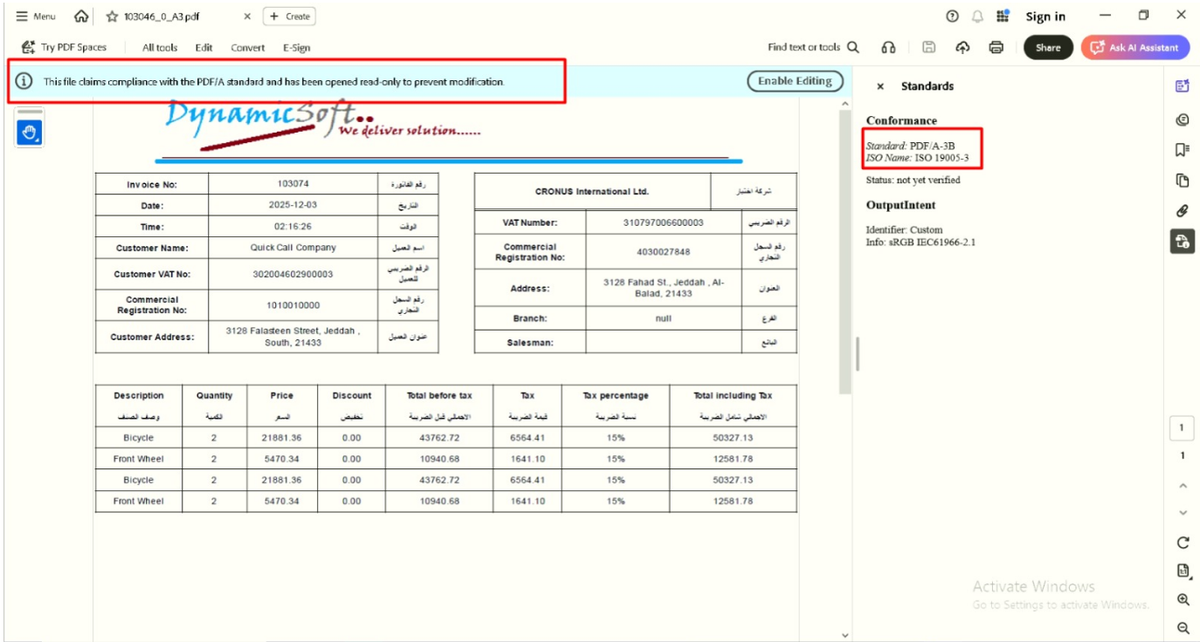
Every taxpayer in scope must generate e-invoices in a structured format using a compliant solution - no more handwritten or unstructured PDF invoices. No connection to ZATCA is required at this stage; the requirement is entirely about how the invoice is created and stored.
Invoices must be generated by a compliant e-invoicing solution, in a structured electronic format - not typed into a generic document or handwritten.
Simplified (B2C-style) tax invoices must carry a QR code encoding the mandatory fields, readable without connecting to any ZATCA system.
Invoices must be stored in a structured, tamper-resistant format - commonly XML or PDF/A-3 with the XML embedded - ready for the integration requirements Phase 2 adds.
Unlike Phase 2, Phase 1 has no cryptographic stamping, UUID, hash chaining, or real-time API submission. Those requirements are introduced with your Phase 2 integration wave - see Phase 2 - Integration.
Where Phase 1 most commonly trips businesses up is storage format and QR code correctness - both easy to get wrong with a spreadsheet-based or generic-PDF invoicing process, and both foundational for the integration work that follows.