
Businesses evaluating e-invoicing readiness are typically choosing between three architectural approaches - and the right choice depends heavily on entity count, ERP diversity, volume and how quickly the business needs to adapt to regulatory change. Choosing the wrong one early is expensive to unwind later.
The diagram below lays out the pros and cons of each approach side by side: Native ERP Integration (build compliance directly into the ERP), Middleware Connector (a lightweight bridge for a single entity/ERP), and Enterprise Middleware (a centralized layer built to scale across multiple entities, countries and ERPs).
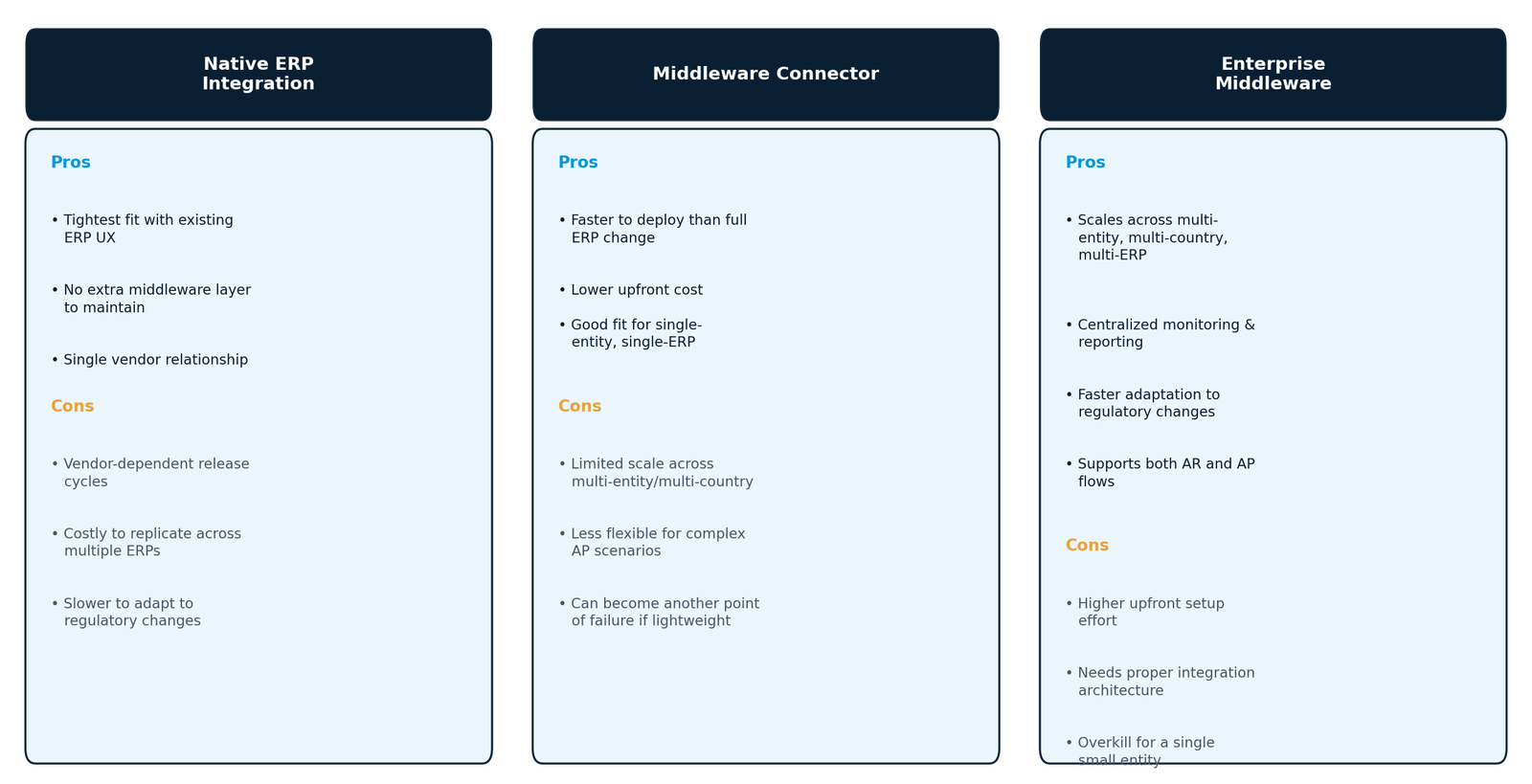
As a rule of thumb: single-entity, single-ERP businesses are often well served by a Middleware Connector; multi-entity or multi-country groups - or anyone expecting to add AP invoice processing - are better positioned long-term with Enterprise Middleware.
Tell us about your ERP and the mandate you fall under — we’ll show you how we’d handle it.