
Most businesses preparing for the FTA mandate assume that appointing an Accredited Service Provider (ASP) is the compliance project. It isn’t. An ASP is the accredited gateway that transmits and receives Peppol messages to and from the FTA network - nothing more. It does not pull data out of your ERP, does not validate it against your master data or business rules, does not convert it into PINT AE UBL 2.1 XML, and does not post incoming AP invoices back into your ERP. That entire layer of work - correct, ongoing, and specific to your business - is the System Integrator’s job. Businesses that skip this distinction typically discover it the hard way: after go-live, when invoices are technically “transmitted” but the data behind them is wrong, or incoming AP invoices sit unprocessed because nothing ever mapped them into the ERP.
We draw a hard line between the two roles on both sides of the flow. On AR (outbound): the SI collects invoice data from the ERP, validates it against business and master-data rules, and converts it into compliant PINT AE XML - the ASP’s only job is to transmit that finished, compliant file across the Peppol network to the FTA and the buyer. On AP (inbound): the ASP simply receives the incoming XML from the network - the SI then validates it against ERP masters (vendor, PO, tax codes), converts it into ERP-native transaction data, and inserts it into the proper AP process (matching, posting, or an exception queue for review). The ASP moves the message. The SI makes the message correct and usable. DynamicSoft operates as the System Integrator - we partner with Registered ASPs for network transmission in the UAE; we are not, and do not present ourselves as, an ASP.
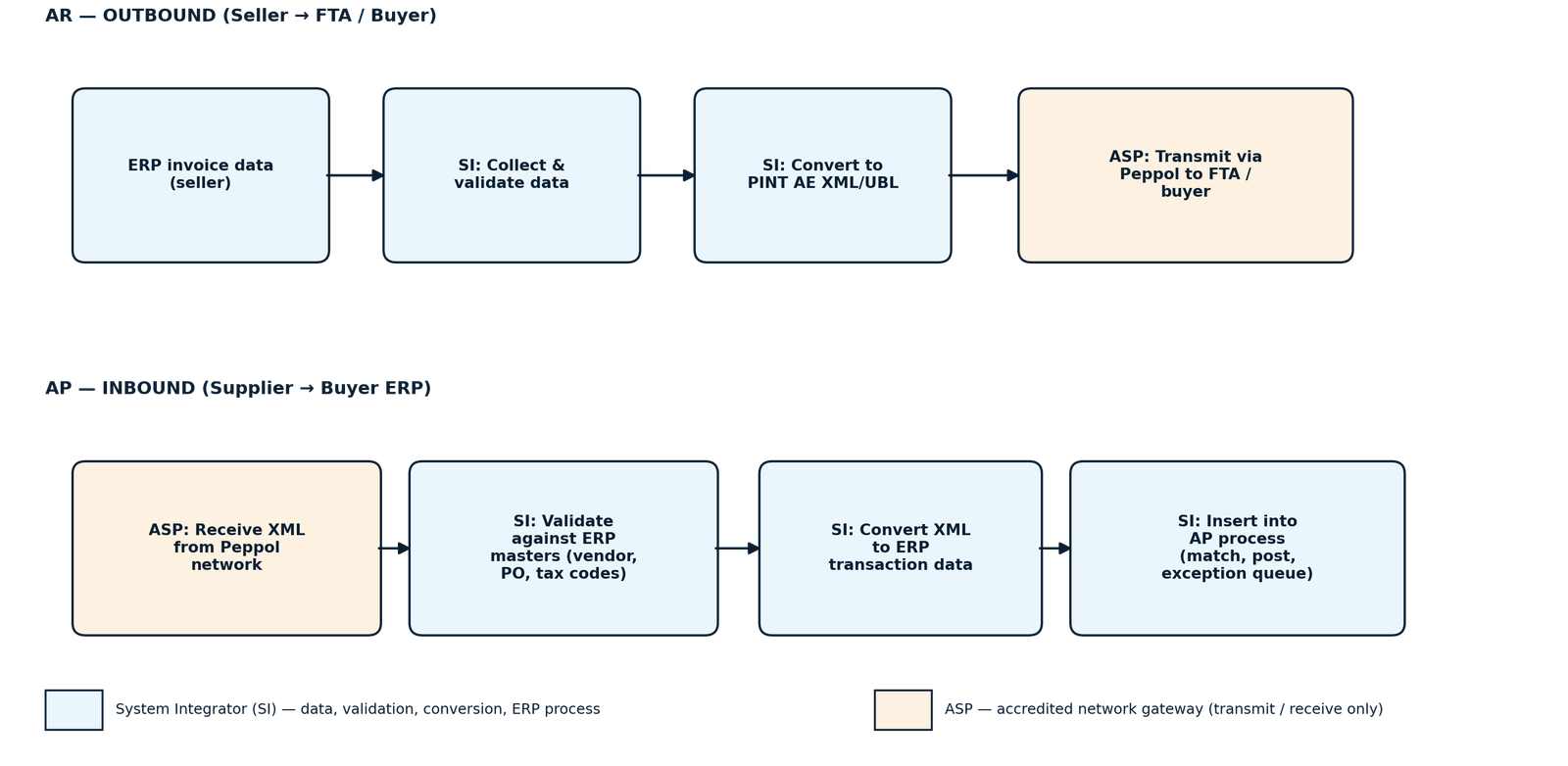
This is why the two decisions carry very different weight. Choosing an ASP is comparatively low-risk and easily reversible - it’s an accredited network connection, and Peppol Participant IDs are designed to be portable if you switch providers. Choosing a System Integrator is a one-time decision that matters: if the integration is built correctly the first time - proper data mapping, proper validation logic, proper AP posting rules - it doesn’t need to be redone. If it’s built poorly, every downstream invoice inherits that risk. That asymmetry also explains ASP pricing behavior: most ASPs don’t carry their own delivery or integration team, so their commercial model concentrates on invoice volume - the more invoices that pass through the gateway, the more they earn, with little incentive tied to whether your underlying data is actually correct. An experienced SI’s value is the opposite: getting the data, business process and conversion right the first time - which is exactly why a genuinely expert SI often ends up costing less over the life of the engagement than a volume-priced ASP relationship layered on top of a poorly-integrated data feed.
A few more distinctions worth weighing side by side: Onboarding effort - ASP onboarding is largely registration and accreditation checks; SI onboarding requires real discovery, data mapping and testing cycles. Change management - when the FTA updates a schema or business rule, the ASP only needs to stay network-compliant, but the SI must update mapping and validation logic to match both the new rule and your ERP - this is where deep, hands-on experience shows. Risk profile - an ASP issue is typically a connectivity/network problem, quickly diagnosed and switchable; an SI issue means wrong data is landing inside your ERP or AP process, which is a business risk, not just a technical one. Incentive alignment - a volume-priced ASP has limited incentive to reduce your invoice error rate; a properly-scoped SI engagement is measured on accuracy and successful automation, not on how many invoices pass through. Data exposure - the SI works close to your sensitive ERP master data (pricing, vendors, tax setup); the ASP only ever sees the final compliant message, never your internal business logic - which is one more reason SI selection deserves real scrutiny, not just a compliance checkbox.
Tell us about your ERP and the mandate you fall under — we’ll show you how we’d handle it.