
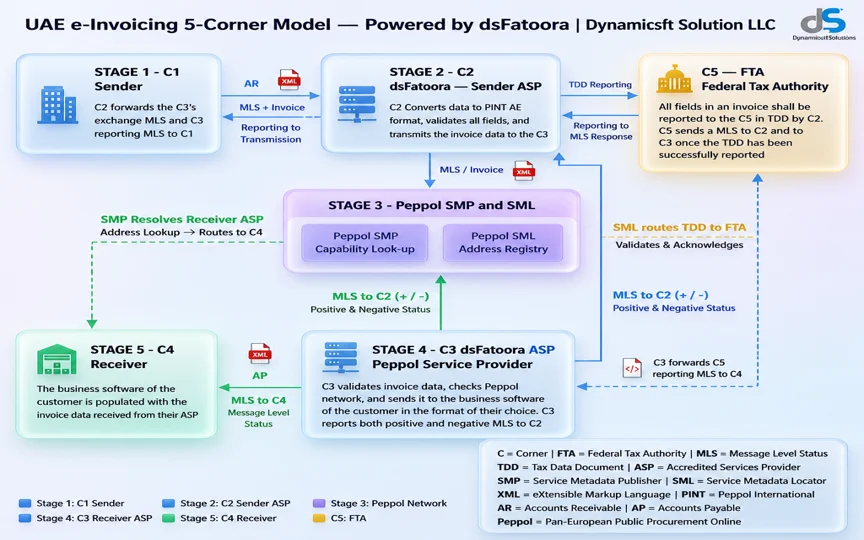
The UAE's Decentralized Continuous Transaction Control and Exchange (DCTCE) model runs on Peppol's 5-corner framework. Confirmed dates: a voluntary pilot from July 2026, mandatory from 1 January 2027. Here's the full picture — and where dsConnectMW fits.
Large businesses (AED 50M+ revenue) must appoint an Accredited Service Provider by 30 October 2026; smaller in-scope businesses by 31 March 2027. An optional pilot runs July–December 2026.
Mandatory for businesses with AED 50 million or more in annual revenue conducting B2B or B2G transactions.
Mandatory for all remaining in-scope businesses, regardless of VAT registration status, including SMEs and free zone entities.
B2B and B2G transactions are mandatory. B2C, certain government sovereign activities, specified airline services, and exempt financial services are explicitly excluded. Only structured XML invoices (UBL / PINT-AE format) transmitted through an Accredited Service Provider qualify as valid e-invoices — a PDF or scanned image will not satisfy the mandate.
Unlike ZATCA's clearance model, the UAE's FTA never sits in the transaction path itself — invoices move directly between Accredited Service Providers, with the FTA's e-Billing System receiving reporting data for compliance monitoring.
Route incoming invoices to the right entity and ERP — even when several companies share one TRN.
Learn more →Validate, sign, and transmit compliant invoices out through your Accredited Service Provider.
Learn more →Connect SAP, D365, Oracle, and more to your chosen Accredited Service Provider with one middleware layer.
Learn more →We'll map your ERP landscape and shared-TRN structure before we talk pricing.
Book a UAE FTA readiness call →